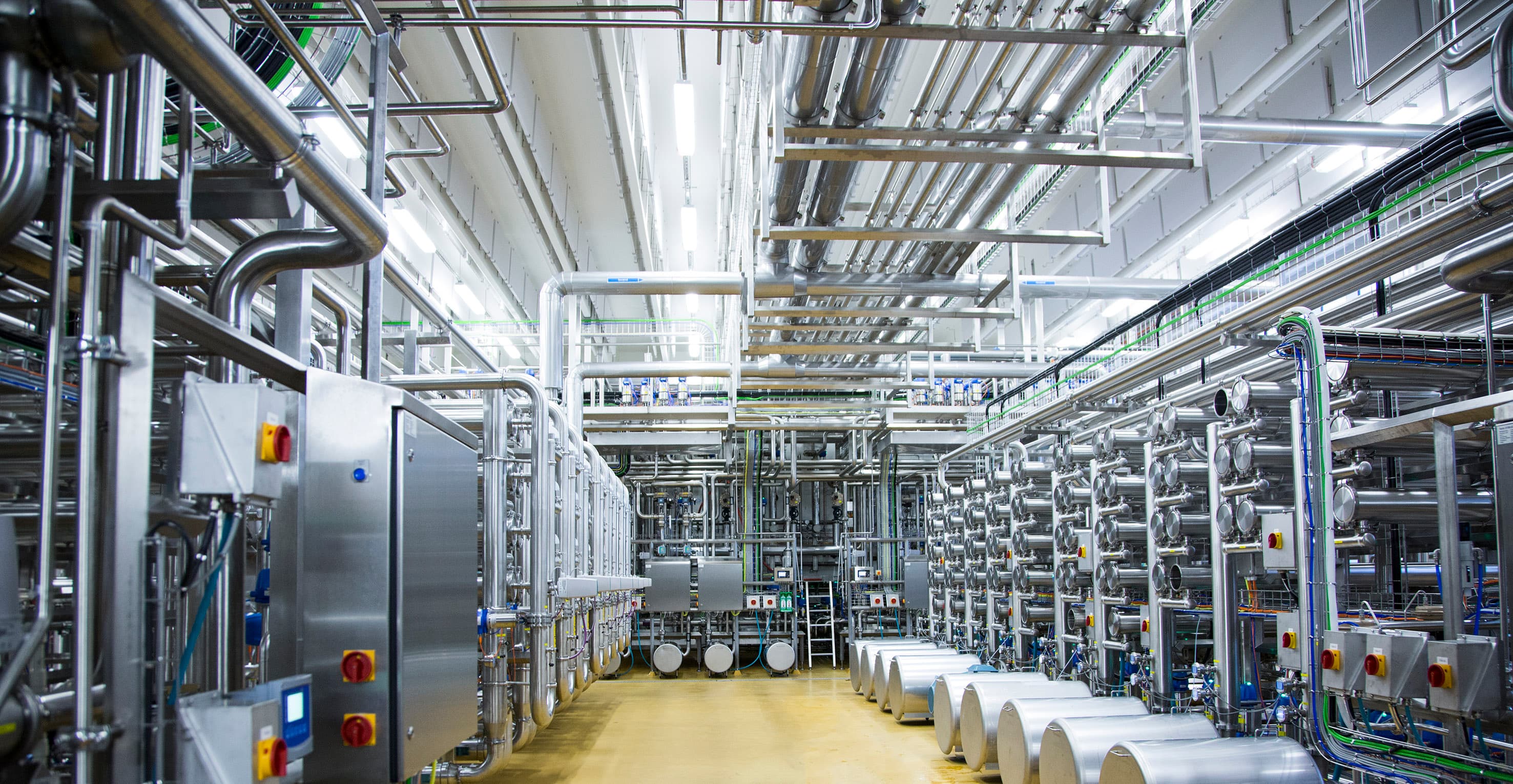
Arla Food Ingredients sees great potential in the use of machine learning after trials at the factory in Videbæk, which halved deviations in product quality and demonstrated opportunities for significant energy savings.
At Arla Foods Ingredients’ factory in Videbæk, West Jutland, whey from cheese production is transformed into specialised powder products. Through the MLEEP pilot project on machine learning (ML), Arla has, with assistance from Viegand Maagøe, optimised parts of the process.
Normally, the work is carried out by operators who monitor and control the process based on regular measurements taken at intervals. An ML system was set up to monitor in real time and continuously suggest adjustments via a digital dashboard.
During the test period, the project team was constantly present, and the operators consistently followed the AI algorithm’s recommendations. The purpose was to determine how much the system could contribute to making the process more stable and the product quality more consistent.
The results from the test period showed a clear improvement. When the operators followed the algorithm’s recommendations, the variation in product quality decreased significantly. The process ran more stably, resulting in both higher and more predictable product quality. At the same time, the trial demonstrated the potential for significant energy savings.
The Machine Learning for Energy and Process Optimization (MLEEP) project investigated, in 2023–25, the possibility of integrating machine learning algorithms directly into Danish industrial companies, where the technology is currently only used to a limited extent.
This was done based on five case companies:
All the companies are from sectors characterized by high energy consumption, but they have very different production processes and challenges when it comes to development and implementation.
The starting point for MLEEP is to use data that is already available within the companies, so they do not need to invest in extensive data collection systems and meters to implement machine learning solutions.
The project is supported by ELFORSK and run by DTU Department of Chemical Engineering, BioLean, and Viegand Maagøe.